
What do an 18th-century gin craze, ancient plant remains and Time Team have in common? Our newest environmental specialist, Karen Stewart!
Karen recently joined Rubicon Archaeology as our Senior Environmental Specialist, bringing with her a wealth of experience in archaeobotany, a love of solving archaeological mysteries and, as it turns out, a particular appreciation for a good gin and tonic.
From uncovering evidence of historic gin production to piecing together the stories hidden in archaeological samples, Karen's work shows that some of the most fascinating discoveries can come from the smallest remains.
We caught up with Karen to find out what first sparked her interest in archaeology, what she enjoys most about her work and why one particular discovery was especially worth raising a glass to.
It All Started with Time Team
Like many archaeologists, Karen's interest in the subject began with a familiar television programme. "Like a lot of people of my generation, it was probably Time Team. I didn't think of it as a possible career until I went to university though - I didn't even know it was a subject you could study, let alone a job you could get paid for."
Today, Karen specialises in archaeobotany, studying plant remains recovered from archaeological sites. Her expertise includes identifying wood species and analysing macroplant remains, helping us understand past environments and the lives of the people who inhabited them.
Solving Mysteries Through Archaeology
As Senior Environmental Specialist, Karen ensures we recover as much information as possible from environmental sampling.
Her work involves everything from sampling archaeological deposits in the field to laboratory processing and coordinating specialist analysis.
But what does she enjoy most? "I love the 'mystery-solving' aspect of my work. If I come across something and don't know what it is, but can do a bit of research and figure it out. That's always a buzz."
It's this curiosity that makes environmental archaeology such an important part of understanding the past. For Karen, the work is about much more than identifying individual remains. It's about helping archaeologists tell a more complete story.
Building the Story of the Past
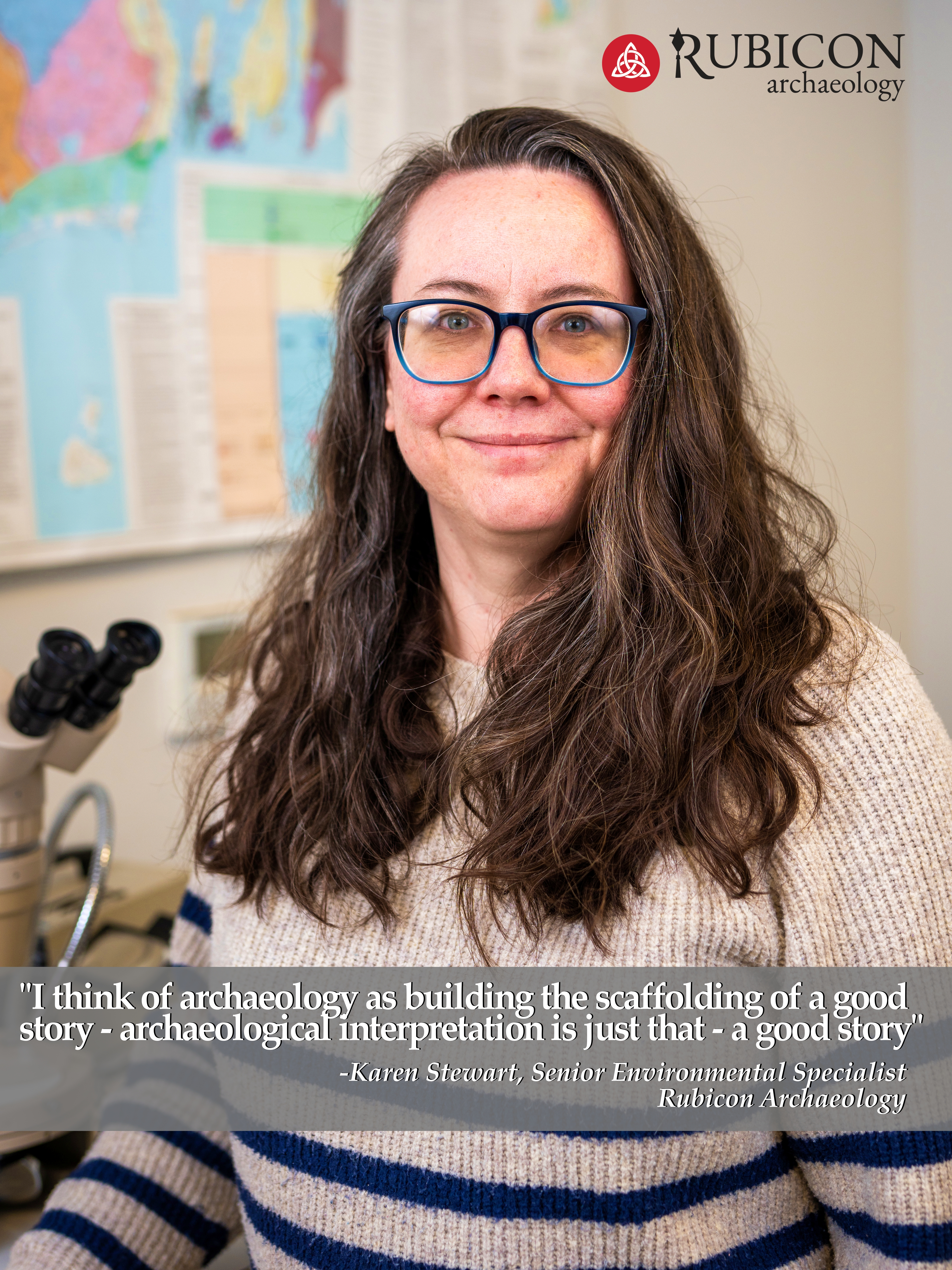
When asked how her role contributes to Rubicon's work, Karen gave us a brilliant description of archaeology. "I think of archaeology as building the scaffolding of a good story - archaeological interpretation is just that - a good story. A good sampling strategy allows for us to fill in the blanks of fieldwork in post-ex; sometimes it's adding some colour to the story, and sometimes it writes a whole new one. One of my personal favourite parts of my job is when I get food remains and can talk about food - food is one of those unifying things that helps us as archaeologists communicate with the public - everyone eats!"
Environmental evidence can reveal details that aren't immediately apparent during excavation, helping us understand everything from diet and agriculture to the use of natural resources. It's also a reminder that some of the most interesting archaeological discoveries aren't necessarily the largest or most visually impressive.
Sometimes, the smallest remains have the biggest stories to tell.
A Discovery Worth Raising a Glass To
Of course, we had to ask Karen about a particularly memorable discovery.
Her answer didn't disappoint! "I'm a fan of a gin and tonic so when I found gin production waste from a site in London I was delighted. It dated right to the height of the gin craze in the first half of the 18th century."
It's not every day that your archaeological work overlaps quite so neatly with your favourite drink!
The discovery also offers a fascinating glimpse into everyday life in 18th-century London, showing how environmental remains can connect us with the habits and experiences of people centuries ago.
Archaeology Doesn't End When Excavation Finishes
Karen is also keen to highlight an important part of archaeological work that doesn't always receive the same attention as excavation.
"Our job isn't finished until all of our data and finds are safely deposited in an appropriate repository and can be reused by researchers in the future."
It's a valuable reminder of the responsibility archaeologists have to preserve the information they recover, ensuring discoveries continue to contribute to research and our understanding of the past.
We're delighted to have Karen's experience and expertise as part of the Rubicon team and look forward to seeing the stories her work helps uncover.
Welcome to Rubicon, Karen!